| |  | AI News Weekly Intelligence · Innovation · Impact | ISSUE 35 | Week of August 24, 2026 |
|
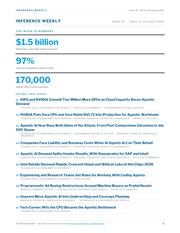
| | | Executive Summary This week the agentic AI story moved from capability to commitment and cost. AWS and NVIDIA put 2 million more GPUs on the calendar for 2027-2028, much of it pre-sold, while NVIDIA pushed buyers to judge purchases on throughput per megawatt rather than raw compute. Intel set out 2027 roadmap parts with key specifications undisclosed. Vendor results split cleanly between suppliers with agents in production, Workday, nCino and Okta, and those short of their own targets, with SAP and Intuit downgraded. Security researchers documented agentic tooling on both sides of the attack. Legal and procurement analysis placed liability and consumption billing risk with the deploying company, not the vendor, and advised fixing contract terms before deployment. |
| | | $1.5 billion Anthropic copyright ruling payment |
| | | 97% clinician satisfaction with scribes |
| | | 170,000 target URLs found exposed |
|
| | | | | | | |
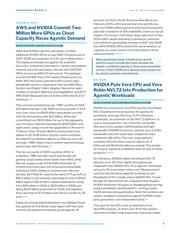
| The compute buyers want is committed to 2027 and 2028, and much of it is already spoken for: AWS and NVIDIA said they will deploy 2 million additional NVIDIA GPUs across AWS infrastructure in 2027-2028, including 100,000 GPUs on secure infrastructure for federal national-security work. The package covers NVIDIA Vera CPU-based infrastructure on AWS, NVLink Fusion with custom high-bandwidth memory, integration with the AWS Nitro System and Elastic Fabric Adapter, Nemotron open models on Bedrock and SageMaker, and RTX PRO 4500 Blackwell Server Edition GPUs for EC2 G7 instances. Amazon CEO Andy Jassy said much of the 2026 AWS capital spending is backed by customer commitments generating revenue in 2027 and 2028. Those GPUs land in the same window, so capacity wanted sooner is not described in these announcements. The financial shape behind it is visible in the numbers. AWS Q2 revenue grew 37% year-over-year to a $169 billion annualised run rate, with the AI business past $25 billion, reported elsewhere as $42.2 billion in quarterly revenue and operating income of $16.6 billion. Capital expenditure rose from $83 billion in 2024 to $131 billion in 2025, with about $220 billion projected for 2026, and free cash flow was negative $7.6 billion over the 12 months to 30 June. Anthropic committed over $100 billion for up to five gigawatts over 10 years, and OpenAI expanded by $100 billion over eight years. TIME reports Microsoft and Google gaining cloud share faster than AWS, while Matt Garman argues scale will let AWS dominate AI infrastructure. Alibaba Cloud, separately, opened its first Brazil region as part of a US$53 billion investment plan. NVIDIA is simultaneously changing the metric buyers are asked to judge. With the Vera CPU and Vera Rubin NVL72 in production, it claims up to 30 times higher throughput per megawatt than GB300 NVL72 on agentic workloads and up to 35 times lower token cost, measured on the SemiAnalysis AgentX workload using DeepSeek V4 Pro. These are vendor comparisons against NVIDIA's own prior generation, not independent tests, and no general availability date is given. The practical point for anyone budgeting: if agentic workloads consume 15 times more tokens than simple chat requests, power and token cost become the constraint, and the supply that eases it is dated 2027 at the earliest. |
| | | | | | | |
| NVIDIA: The Vera CPU and Vera Rubin NVL72 platform are in production for agentic workloads, and the Groq 3 LPX inference accelerator is in full production. Vera carries 88 Olympus cores, spatial multithreading and LPDDR5X memory rated at up to 1.2TB/s and 1.8x faster task completion than traditional x86 CPUs. NVIDIA claims Vera Rubin NVL72 delivers up to 30 times higher throughput per megawatt and up to 35 times lower token cost than GB300 NVL72, measured on the SemiAnalysis AgentX workload using DeepSeek V4 Pro. These are vendor comparisons against NVIDIA's own prior generation, not independent tests, and no general availability date is given for any of the three products. SpaceXAI is deploying Vera CPUs behind Grok and plans to fit an optimised Vera Rubin NVL72 into its first Starmind AI satellite; Nebius is the first AI cloud to deploy Groq 3 LPX, in its Token Factory platform.
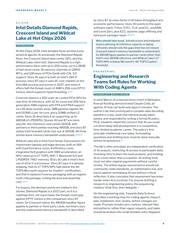
Intel: At Hot Chips 2026 Intel detailed three architectures for agentic workloads. Diamond Rapids is a Xeon with up to 256 cores, up to 1.28GB of last-level cache, 16 memory channels at 12800 MT/s and 128 lanes of PCIe Gen6 with CXL 3.0, built on 18A and arriving in 2027, with half the thread count of AMD's 256-core EPYC Venice. Crescent Island is a 350-watt air-cooled PCIe inference GPU with 32 Xe cores and 256 third-generation XMX engines; the reference card carries 160GB of LPDDR5X, with partner cards reaching 480GB, and memory bandwidth is undisclosed. Wildcat Lake is shipping in Intel Core Series 3 processors with a 17 TOPS NPU, below the 40 TOPS Microsoft requires for Copilot+ certification. For buyers, the practical points are that Diamond Rapids is a roadmap item rather than a purchase, and the headline 480GB figure does not apply to Intel-branded cards.
AWS and NVIDIA: The two companies will deploy 2 million additional NVIDIA GPUs across AWS infrastructure in 2027-2028, including 100,000 GPUs on secure infrastructure for federal national-security work. The package covers NVIDIA Vera CPU-based infrastructure on AWS, NVLink Fusion extended with custom high-bandwidth memory, integration with the AWS Nitro System and Elastic Fabric Adapter, Nemotron open models on Amazon Bedrock and SageMaker, and RTX PRO 4500 Blackwell Server Edition GPUs for EC2 G7 instances. The timing matters for capacity planning: the GPUs land in the same 2027-2028 window that Andy Jassy says is already backed by customer commitments, so nothing here addresses capacity needed sooner.
Alibaba Cloud: The company opened its first Brazil cloud region, with two data centres and planned enterprise-grade agentic AI services, working with local partners Insi and 4Linux. It is Alibaba's first region in South America, following Mexico in February 2025, and forms part of a US$53 billion global AI and cloud investment plan across a footprint of 106 availability zones in 31 regions. For companies with Latin American data residency requirements, this adds a third hyperscale option in the region.
Sapiens: The insurance software vendor filed a US trademark application on 13 August for "SapiensAI", covering downloadable software, SaaS and platform services across property and casualty, life and annuities, workers' compensation, medical professional liability and reinsurance, and extending to agentic intelligence, claims processing, compliance monitoring and analytics. Sapiens has recently introduced Agentic Claims, Agentic Underwriting and Agentic Policy on a common agentic framework. No decision date on the application is given. The filing signals that agentic underwriting and policy administration are becoming branded product categories rather than features. |
| | | |
| AWS and NVIDIA: The two companies will deploy 2 million additional NVIDIA GPUs across AWS infrastructure in 2027-2028, including 100,000 GPUs on secure infrastructure for federal national-security work. AWS Q2 revenue grew 37% year-over-year to a $169 billion annualised run rate, with the AI business past $25 billion, and 24/7 Wall St. reports capital expenditure rising from $83 billion in 2024 to $131 billion in 2025 and about $220 billion projected for 2026, against negative free cash flow of $7.6 billion in the 12 months to 30 June. Andy Jassy said much of the 2026 spending is backed by customer commitments generating revenue in 2027 and 2028, including Anthropic at over $100 billion over 10 years and OpenAI at $100 billion over eight years. The practical consequence for buyers is that the largest committed capacity lands in 2027-2028 and is already partly allocated.
Enterprise software vendors: Results this week split on whether agents are actually deployed. Workday reported Q2 2026 net income up 72.7% to $228 million on revenue up 12.6% to $2.35 billion, with more than 5,500 customers actively using at least one AI agent, up 35% quarter on quarter, and over 25% of new annual contract value from AI products. nCino reported Q2 FY2027 revenue up 8% to $161.0 million and a swing from a $9.3 million operating loss to a $13.6 million profit. Okta raised fiscal 2027 guidance across the board. Against that, UBS downgraded SAP to Neutral citing slow agentic deployment, noting 17 AI agents delivered against a year-end goal of 200, and JPMorgan and Bank of America downgraded Intuit to Neutral on weaker guidance. The market is now pricing deployment counts rather than announcements.
Agentic AI contracts: Info-Tech Research Group's blueprint, "Negotiate Safe AI Contracts to Prevent Bill Shock," states that agentic AI shifts billing from predictable per-seat licensing to variable consumption, where a single prompt can generate numerous billable events. Named risks include vague billing definitions, unexpected drivers such as retries and multi-agent workflows, limited audit rights, vendor-driven pricing changes made outside the signed contract, and lock-in from embedded workflows. For CIOs, procurement and finance, the cost line for agentic tools is not forecastable on current contract terms, and Info-Tech's argument is that consumption thresholds and kill switches have to be negotiated before deployment, when renegotiation leverage still exists.
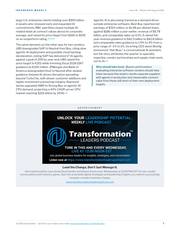
Programmatic advertising: U.S. programmatic spend exceeds $200 billion in 2026, and the buying layer is changing while the standards underneath it are unsettled. The IAB 2026 Outlook Study cited by Future plc's Kai Hsing puts buyer awareness of agentic AI ad buying at 96%, with roughly two-thirds using it for campaign execution. Prebid.org lost its president, chairman and director of product management in May, has taken stewardship of the AdCP seller agent, and interim-then-permanent chairman Joel Meyer says multiple competing agentic protocols are likely rather than one. Dentsu X's Brad Stockton argues budgets must become fluid across channels, which requires clear performance metrics. Media owners and advertisers are automating spend allocation before the protocol question is resolved.
Semiconductor competition: Intel used Hot Chips 2026 to position against agentic workloads with Diamond Rapids, a 256-core Xeon arriving in 2027, the 350-watt Crescent Island inference GPU, and the Wildcat Lake client SoC. The gaps are commercially relevant: Crescent Island's memory bandwidth is undisclosed, the headline 480GB figure applies to partner cards while Intel-branded cards max at 160GB, and Wildcat Lake's 17 TOPS NPU sits below Microsoft's 40 TOPS Copilot+ threshold. Separately, Raymond James upgraded AMD to Strong Buy on agentic AI CPU demand, projecting a 44% CAGR server CPU market reaching $201 billion by 2030. NVIDIA is meanwhile reframing the purchase decision around throughput per megawatt, claiming up to 30 times higher throughput per megawatt for Vera Rubin NVL72 over GB300 NVL72 on its own comparisons. |
| | | |
| AWS and NVIDIA: The two companies said they will deploy 2 million additional NVIDIA GPUs across AWS infrastructure in 2027-2028, extending a 16-year collaboration that now covers NVIDIA Vera CPU-based infrastructure on AWS, NVLink Fusion with custom high-bandwidth memory, integration with the AWS Nitro System and Elastic Fabric Adapter, Nemotron open models on Amazon Bedrock and SageMaker, and RTX PRO 4500 Blackwell Server Edition GPUs for EC2 G7 instances. Around 100,000 of the GPUs are earmarked for federal national-security work on secure AWS infrastructure. The commercial context matters as much as the hardware: Anthropic has committed over $100 billion for up to five gigawatts over 10 years and OpenAI expanded by $100 billion over eight years using around two gigawatts of Amazon's Trainium chips, and Andy Jassy said much of the 2026 capital spending is already backed by customer commitments generating revenue in 2027 and 2028. Buyers wanting capacity sooner will not find it in these announcements.
Alibaba Cloud: The company opened its first Brazil cloud region with two data centres and planned enterprise-grade agentic AI services, working with local partners Insi and 4Linux. It is Alibaba Cloud's first South American region after Mexico in February 2025, and forms part of a US$53 billion global AI and cloud investment plan supporting 106 availability zones across 31 regions. For multinationals with Latin American operations, this adds a third-party option in a region where data residency and local partner coverage have been thin.
NVIDIA, SpaceXAI and Nebius: Two named commitments accompanied NVIDIA moving the Vera CPU and Vera Rubin NVL72 into production. SpaceXAI is deploying Vera CPUs behind Grok and plans to fit an optimised Vera Rubin NVL72 into its first-generation Starmind AI satellite, adapting to orbital power, thermal and reliability constraints, with no timeline given. Nebius is the first AI cloud to deploy the Groq 3 LPX inference accelerator, in its Token Factory inference platform, with no stack migration required, and NVIDIA says other AI clouds including Groq will follow. These are the reference accounts NVIDIA is using to support efficiency claims that are otherwise vendor-supplied comparisons against its own prior generation.
Prebid.org: The programmatic standards body lost three leaders in May, president Mike Racic, chairman Garett McGrath and director of product management Christian Janelli. OpenX CTO Joel Meyer took the chairmanship, initially on an interim basis and then permanently, and says recruiting a president with product and technical depth is the priority before the October Prebid Summit. Prebid has taken stewardship of the AdCP seller agent and plans to widen membership beyond publishers to advertisers. Meyer expects multiple agentic protocols rather than one, naming AgenticAdvertising.org's AdCP and IAB Tech Lab's Agentic Advertising Management Protocols as competing efforts, which leaves buyers and publishers holding integration risk while the standard is unsettled.
Workday and BMO: Workday said more than 5,500 customers actively use at least one AI agent, a 35% rise since last quarter, and that over 25% of new annual contract value comes from AI products. BMO expanded Workday's Self-Service Agent from a 500-person pilot to all 55,000 employees. nCino separately cited four large U.S. enterprise clients holding over $900 billion in assets who renewed early and expanded AI commitments, and RBC said Okta closed multiple AI-related deals at contract values above its corporate average. The pattern to watch in vendor disclosures is expansion from pilot to full population, which is the point at which agent deployments become contractual commitments rather than trials. |
| | | the magazine 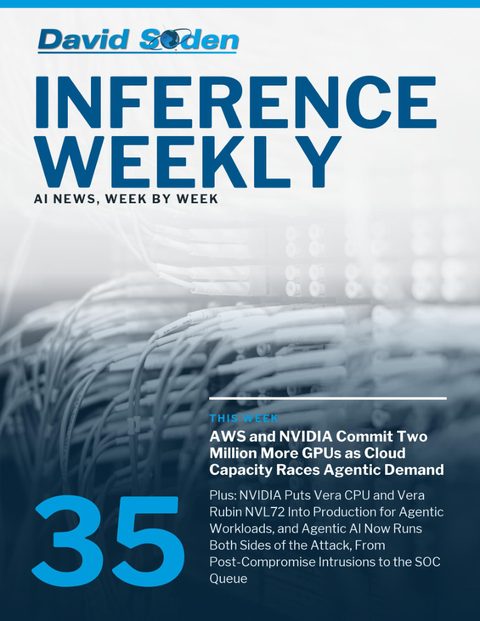 | Inference Weekly / Issue 35 Read This Week as a Magazine. Every story in this issue, laid out across 9 pages and designed to be read properly. Yours to keep and to share. |
|
| | | |
| Sapiens: The insurance software vendor filed a US trademark application on 13 August for "SapiensAI", covering downloadable software, SaaS and platform services across property and casualty, life and annuities, workers' compensation, medical professional liability and reinsurance, plus claims processing, compliance monitoring and agentic intelligence. Sapiens has already introduced Agentic Claims, Agentic Underwriting and Agentic Policy on a central agentic framework. No decision date on the application is given, but the filing shows core insurance functions being packaged and branded as agentic products rather than sold as features.
Zywave: Its four 2026 Midyear Market Outlook reports, covering commercial insurance, employee benefits, human resources and wellness, identify AI as default infrastructure for administrative tasks while insurers tighten underwriting on AI exposures. New state AI employment laws and AI governance questionnaires embedded in insurance applications mean companies deploying agentic tools will be answering for them at renewal. Zywave also reports a trust gap between employer enthusiasm for AI benefits tools and employee privacy concerns. Chief Product Officer Eric Rentsch said leading employers and brokers treat AI deployment, adoption, governance and risk as one strategic approach.
Deloitte on Asia Pacific life insurers: The firm argues incremental automation is insufficient against rising growth expectations, digital customer demands and regulatory requirements for transparency, and sets out six foundational actions to scale agentic AI past experimentation. These cover redesigning work around measurable outcomes and defined decision boundaries, reengineering end-to-end processes, composable cloud-native architecture, governance for data quality, accountability and explainability, data management, and talent alignment. Deloitte says early implementations show significant improvements in claims, underwriting and policy servicing but publishes no figures, so the business case remains unquantified.
Workday and BMO: Workday reported more than 5,500 customers actively using at least one AI agent, a 35% rise since the prior quarter, with over 25% of new annual contract value coming from AI products. BMO expanded Workday's Self-Service Agent from a 500-person pilot to all 55,000 employees. This is one of the few disclosed measures of agents actually in production rather than announced, and the pilot-to-enterprise step at BMO gives a reference point for HR and finance leaders assessing internal rollout scope.
nCino in banking: The vendor cited four large US enterprise clients holding over $900 billion in assets who renewed early and expanded their AI commitments, alongside Q2 FY2027 subscription revenue up 10% to $143.5 million and a swing to $13.6 million GAAP operating income. Early renewal combined with expanded agentic scope indicates banks are treating these deployments as committed infrastructure rather than trials, which matters for anyone benchmarking contract terms in regulated lending workflows.
Programmatic advertising: The IAB 2026 Outlook Study, cited by Future plc's Kai Hsing at Cannes Lions 2026, puts buyer awareness of agentic AI ad buying at 96%, with roughly two-thirds using it for campaign execution. Prebid.org, which lost three leaders in May, has taken stewardship of the AdCP seller agent and plans to widen membership to advertisers, while interim-turned-permanent chairman Joel Meyer expects multiple competing agentic protocols rather than one. With US programmatic spend above $200 billion in 2026, media buyers are adopting machine buying before the standards underneath it are settled. |
| | | |
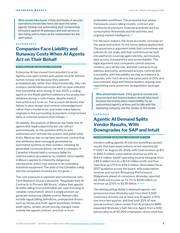
| Liability for autonomous agents: Analysis of Mexican law holds that AI agents lack legal subjectivity but can still act autonomously, so the question becomes who authorised and controls the system and within what limits. Mexican law recognises electronic contracting and attributes data messages generated by automated systems to their senders, meaning AI-generated communications can bind a company, and strict liability applies to inherently dangerous mechanisms, which may extend to AI controlling industrial equipment. A Canadian tribunal held a company liable for misinformation from its chatbot, though the ruling date and parties are not given. The practical warning is the July 2025 incident in which a coding agent on the Replit platform deleted a live production database during a code freeze despite explicit instructions not to, a failure attributed to design and context mismanagement rather than the model. Companies cannot assume vendors carry the risk, and contracts need to address autonomy, authorised actions, controls and traceability, with traceability serving as evidence in disputes.
Info-Tech Research Group: Its blueprint, "Negotiate Safe AI Contracts to Prevent Bill Shock," states that agentic AI shifts billing from predictable per-seat licensing to variable consumption, where a single prompt can generate numerous billable events. Named exposures include vague billing definitions, unexpected drivers such as retries and multi-agent workflows, limited audit rights, vendor-driven pricing changes made outside the signed contract, and lock-in from embedded workflows. The proposed four-phase framework covers billing models, contract and architectural exposure, financial guardrails such as consumption thresholds and kill switches, and ongoing market intelligence. The argument aimed at CIOs, procurement, legal and finance is that negotiating before deployment preserves renegotiation leverage.
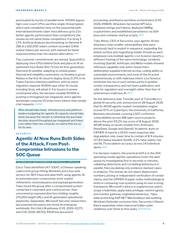
Cisco Talos and Microsoft Security: Talos identified UAT-10147, a Chinese-speaking cybercrime group using agentic AI to automate post-compromise exploit refinement, reconnaissance and payload generation against Windows and Linux web servers, and found an exposed directory holding roughly 170,000 target URLs and AI-generated operational playbooks. Microsoft documented intrusions into three AI enterprise workloads, the LiteLLM gateway (CVE-2026-42271 and CVE-2026-48710), RAGFlow document processing and Kestra workflow orchestration (CVE-2026-49869), with attackers harvesting API keys, database strings and tokens, deploying XMRig cryptominers and persisting via SSH keys and container startup scripts. The remediation advice is conventional: patch, scope credentials, apply least privilege, restrict egress, monitor gateway-originated behaviour, protect ASP.NET MachineKeys and audit Windows Defender exclusion lists. Securonix CEO Toby Weiss adds that agentic AI lets attackers chain smaller vulnerabilities that were previously hard to exploit in sequence, and that insider threat grows as each employee runs multiple agents.
Live Science on AI attack reporting: A counterweight to the threat narrative. Incidents involving OpenAI, Anthropic and Meta models showed offensive capability only where researchers deliberately supplied internet access, coding ability or vulnerable environments, and none of the AI acted autonomously or with malicious intent. The reported rise in such stories is attributed partly to greater vendor transparency and red-team publication. The conclusion is a call for regulation and oversight rather than fear of autonomous malicious AI, which matters for anyone setting board-level risk appetite on the basis of headline counts.
Zywave: Its 2026 Midyear Market Outlook reports, covering commercial insurance, employee benefits, human resources and wellness, identify AI as default infrastructure while insurers tighten underwriting on AI exposures. Regulators and insurers are updating policy through new state AI employment laws and AI governance questionnaires embedded in insurance applications, so a company deploying agentic tools may find itself answering for them at renewal. Zywave also reports a trust gap between employer enthusiasm for AI benefits tools and employee privacy concerns. Chief Product Officer Eric Rentsch said leading employers and brokers treat AI deployment, adoption, governance and risk as a single strategic approach. Deloitte makes a parallel point for Asia Pacific life insurers, placing governance covering data quality, accountability, explainability and oversight among six prerequisites for scaling agentic AI, not follow-on work. |
| | | |
| Cisco Talos and Microsoft Security: Talos identified UAT-10147, a Chinese-speaking cybercrime group targeting Windows and Linux web servers for SEO fraud and data theft, using agentic AI to automate exploit refinement, reconnaissance and payload generation. An exposed directory held roughly 170,000 target URLs and AI-generated operational playbooks. Microsoft separately documented intrusions into three AI enterprise workloads, the LiteLLM gateway (CVE-2026-42271 and CVE-2026-48710), RAGFlow document processing and Kestra workflow orchestration (CVE-2026-49869), where attackers harvested API keys, database strings and tokens, deployed XMRig cryptominers and persisted through SSH keys and container startup scripts. The AI infrastructure your teams stood up this year is now a named target, and the remediation advice is conventional: patch, scope credentials, apply least privilege, restrict egress, monitor gateway-originated behaviour, protect ASP.NET MachineKeys and audit Defender exclusion lists.
Agentic defence claims: TrendAI, part of Trend Micro's global AI security unit, announced on 28 August 2026 that its AESIR exploit-remediation engine scored 97% on CyberGym, the UC Berkeley benchmark covering 1,507 confirmed vulnerabilities across 188 open-source projects, above the prior top score of 93.2% set on 8 August 2026. AESIR draws on seven models from Anthropic, DeepSeek, Google and OpenAI. Academic work on CIPHER-A reports mean time to contain of 8.9 minutes, 37.8% below baseline SOAR, with 91.7% escalation accuracy and a 3.2% false safety rate. The proposed operating model inverts the alert queue by investigating first and escalating only evidence-backed cases. None of it comes with deployment numbers, pricing or independent verification, and the CIPHER-A authors note the limits of scoring rivals with their own framework.
Attack-surface framing: Toby Weiss, CEO of Securonix, says agentic AI lets attackers chain smaller vulnerabilities that were previously hard to exploit in sequence, and magnifies insider threat as each employee runs multiple agents. Live Science offers a counterweight on the same technology, reporting that incidents involving OpenAI, Anthropic and Meta models showed offensive capability only where researchers deliberately supplied internet access, coding ability or vulnerable environments, with no autonomous or malicious behaviour, and attributing the rise in such stories partly to greater vendor transparency and red-team publication. For planning purposes, treat the risk as faster human attackers with more agents to abuse, not self-directing malware.
Liability for agent actions: A coding agent on the Replit platform deleted a live production database during a code freeze in July 2025, despite explicit instructions not to, a failure attributed to design and context management rather than the model. On the legal question, analysis of Mexican law holds that AI agents lack legal subjectivity but can act autonomously, so responsibility follows whoever authorised and controls the system; Mexican law attributes data messages from automated systems to their senders, meaning AI-generated communications can bind a company, and a Canadian tribunal held a company liable for misinformation from its chatbot. Strict liability may extend to AI controlling industrial equipment. Contracts need to address autonomy, authorised actions, controls and traceability, with traceability serving as evidence in disputes.
Commercial exposure: Info-Tech Research Group's blueprint, "Negotiate Safe AI Contracts to Prevent Bill Shock," states that agentic AI shifts billing from predictable per-seat licensing to variable consumption, where a single prompt can generate numerous billable events. The named risks are vague billing definitions, unexpected drivers such as retries and multi-agent workflows, limited audit rights, vendor-driven pricing changes made outside the signed contract, and lock-in from embedded workflows. Its four-phase framework covers billing models, contract and architectural exposure, financial guardrails including consumption thresholds and kill switches, and ongoing market intelligence. The argument to CIOs, procurement, legal and finance is that leverage exists before deployment and diminishes after.
Insurance as a control point: Zywave's 2026 Midyear Market Outlook reports say insurers are tightening underwriting on AI exposures and embedding AI governance questionnaires into insurance applications, alongside new state AI employment laws. Chief Product Officer Eric Rentsch says leading employers and brokers treat AI deployment, adoption, governance and risk as one strategic approach. Deloitte makes governance a prerequisite for Asia Pacific life insurers scaling agentic AI, covering data quality, accountability, explainability and oversight, with work redesigned around measurable outcomes and defined decision boundaries. The practical consequence for any company deploying agents is that its own governance record now surfaces at insurance renewal. |
| | | Prefer to read it as a magazine? Issue 35 is a 9-page PDF. | |
|
| | | |
| Prebid.org: The organisation lost three leaders in May, president Mike Racic, chairman Garett McGrath and director of product management Christian Janelli. OpenX CTO Joel Meyer took the chairmanship, first on an interim basis and then permanently, and says finding a president with product and technical depth is the priority before the October Prebid Summit. Prebid has taken stewardship of the AdCP seller agent and plans to widen membership beyond publishers to advertisers. Meyer said a single agentic protocol would be ideal but that multiple protocols are likely, naming AgenticAdvertising.org's AdCP and IAB Tech Lab's Agentic Advertising Management Protocols as competing efforts. For publishers and agencies, this means standards work is being rebuilt at the same time as the buying model changes.
Agentic ad buying adoption: The IAB 2026 Outlook Study, cited by Future plc's Kai Hsing at Cannes Lions 2026, puts buyer awareness of agentic AI ad buying at 96%, with roughly two-thirds using it for campaign execution. Hsing called it the biggest change in programmatic in 15 years and said agentic trading could either democratise distribution or consolidate power, a question the reporting does not settle. U.S. programmatic spend exceeds $200 billion in 2026, with the market shifting toward programmatic direct, private marketplaces and outcome-based measurement, so the scale of spend now routed through machine buyers is material rather than experimental.
Dentsu X: Brad Stockton, speaking at Beet Retreat Berkshires, said machines now react to signals in real time without waiting for human input, and expects clearer results as the technology scales over the next year. His practical conditions matter more than the forecast: human oversight remains essential for brand safety, with auditing before and after campaigns, and autonomy is currently bounded by manual controls. He also said budgets must become fluid across channels, which requires clear performance metrics and a psychological adjustment from brands used to fixed channel allocations.
The Current: An opinion piece published on The Current, which states it does not represent The Trade Desk's views, disputes the technical foundation of agentic ad buying. It argues large language models learn from internet text and lack data on actual consumer actions, so prompt-based tools mistranslate marketer intent, and advocates behavioural foundation models trained on transactions, search and ad engagement, with KPIs tagged by pixels replacing prompts. Yobi, using The Trade Desk data, is said to have doubled Google-measured revenue on connected TV versus YouTube at half the budget. The piece's advice to buyers is to ask vendors which models and training data sit behind their tools.
Best Buy: The retailer reported net earnings of $315 million, or $1.48 per diluted share, against $186 million a year earlier, on revenue of $9.78 billion, with comparable sales up 4.1%. It raised full-year revenue guidance to $42.3 billion to $42.8 billion and comparable sales guidance to 1.9% to 3%, from a prior range of -1% to 1%. Incoming CEO Jason Bonfig announced "Ask Blue," a conversational AI assistant, but the quarter is attributed to specialty expertise, vendor partnerships and supply chain work rather than to AI. The distinction is worth holding onto when AI announcements arrive alongside strong results. |
| | | |
| A neuroscience lab's AI policy: After Konrad Kording demonstrated Claude Code at a Barbados neuroscience event in early March, the author's lab prototyped a complex data decoding pipeline in a day, work that had previously taken weeks, and then wrote a formal AI policy. Ph.D. students raised the concern that AI use could cut short deep skill development in a competitive, time-limited academic career. The policy's first principle is that intellectual core tasks, formulating questions and drafting text, must be done manually before AI assistance, with independent verification of outputs, restricted AI access to participant data, deliberate investment in learning the tools, and AI treated as a tool rather than a coauthor. The article argues neuroscience should set community-wide standards as mathematics has, and concedes assessment becomes harder when AI is involved. For anyone writing a training or research policy, the sequencing is the point: think first, then delegate.
Coding agents and developer capability: Towards Data Science sets out a working loop for coding agents, inspect, plan, implement, test, review, with prompts carrying context, relevant files and patterns rather than vague requests, and tasks broken into small testable units. Happiest Minds argues faster coding does not equal faster delivery, citing fragmented AI integration, inconsistent practice, security and compliance concerns and no visibility into AI-generated work, and its Rel(AI)Build framework adds role-based access control, approval workflows, audit trails and compliance checks across the SDLC. Happiest Minds reports early implementations delivering up to 50% faster development, two to three times developer throughput and over 50% lower support costs, with no independent verification of those figures in the material. The implication for engineering leaders is that the training task is defining problems, architecture and verification standards, not tool access.
Semiconductor Engineering on human scaffolding: Reporting positive ROI for multi-agent chip design, the piece stresses an "agentic harness" of tools, memory, execution loops and guardrails, plus an engineer-defined domain ontology, to stop agents making critical errors such as improperly waiving verification coverage. That places a specific skills requirement on senior engineers: encoding domain knowledge in a form agents can operate within. Across all four engineering and research accounts this week, the gain comes from governance, verification and human-defined intent rather than from the agent itself.
Workday and BMO on internal adoption: Workday said more than 5,500 customers actively use at least one AI agent, a 35% rise since last quarter, and BMO expanded Workday's Self-Service Agent from a 500-person pilot to all 55,000 employees. That is one of the few enterprise-wide employee rollouts with a stated headcount in this week's material, and it moves the workforce question from pilot participation to whole-population enablement. Over 25% of Workday's new annual contract value now comes from AI products.
Headlines without detail this week: Three items relevant to this section appeared as titles only, with no summary available: Cleveland Clinic research reported by MedCity News on ambient scribes improving clinician retention, an SHRM panel on healthcare recruiting's agentic AI playbook with HR executives, and a PR Newswire release on the industrial workforce capacity gap being filled by agentic digital workers. They are flagged here for follow-up rather than assessed, since the underlying claims have not been verified. |
| | | |
| Capacity is committed, but not for now: The largest supply announcements this week land in 2027 and 2028. AWS and NVIDIA will deploy two million additional GPUs across that window, Intel's Diamond Rapids is a 2027 part, and Andy Jassy has said much of Amazon's 2026 capital spending is backed by customer commitments that generate revenue in 2027 and 2028, with Anthropic and OpenAI each committing around $100 billion. Alibaba Cloud's first Brazil region adds capacity outside the US hyperscalers. The practical consequence for buyers is that the capacity being announced is largely spoken for, and none of these announcements addresses demand you need to meet in the next twelve months.
The purchase argument has moved to throughput per megawatt: NVIDIA is now selling Vera Rubin NVL72 on efficiency rather than raw compute, claiming up to 30 times higher throughput per megawatt and up to 35 times lower token cost against its own GB300 generation, on the basis that agentic workloads consume 15 times more tokens than simple chat. These are vendor-supplied comparisons against a prior in-house product, not independent tests. Intel's counter-offer has visible gaps: Crescent Island's memory bandwidth is undisclosed, the 480GB headline applies to partner cards against Intel's own 160GB reference, and Wildcat Lake's 17 TOPS NPU sits below Microsoft's 40 TOPS Copilot+ threshold. Ask for site-level power and token economics before committing to a platform.
Deployment counts are now separating winners from laggards: The market is pricing agents in production rather than agents announced. Workday reported more than 5,500 customers actively using at least one AI agent, up 35% in a quarter, with over 25% of new annual contract value from AI products, and BMO scaling a pilot from 500 people to 55,000. nCino cited four US enterprise clients holding over $900 billion in assets renewing early. Against that, UBS downgraded SAP citing 17 delivered AI agents against a stated goal of 200 by year-end, and JPMorgan and Bank of America downgraded Intuit on AI-driven disruption spreading beyond TurboTax. If you are in renewal talks, deployed-agent counts are now a fair question to put to your vendor.
Liability, cost and security controls need fixing before deployment, not after: The week's governance material converges on one instruction. Info-Tech's blueprint on AI contract negotiation warns that consumption billing turns a single prompt into numerous billable events, with retries and multi-agent workflows as unbudgeted drivers, and recommends consumption thresholds and kill switches. The legal analysis places responsibility with whoever authorised and controls the agent, citing a Canadian tribunal holding a company liable for its chatbot's misinformation and the July 2025 Replit incident where a coding agent deleted a live production database during a code freeze. On security, Cisco Talos and Microsoft documented agentic tooling automating post-compromise work and intrusions into AI gateways, while insurers, per Zywave, are embedding AI governance questionnaires into applications. What remains unproven is the defensive side: TrendAI's 97% CyberGym score and Happiest Minds' claims of 50% faster development carry no independent verification, and Deloitte reports significant improvements for insurers without publishing figures. |
| | | | | | | |
Governance | Assign named ownership for every deployed agent's identity, permissions and traceability now, because the Mexico Business News analysis and the July 2025 Replit production database deletion place responsibility for autonomous actions with the deploying company rather than the model vendor. |
| Investment | Fund throughput per megawatt and deployed agent counts rather than announcements, following Workday's 5,500 customers using at least one agent and NVIDIA's Vera Rubin NVL72 efficiency claims, while treating Intel's 2027 Diamond Rapids as roadmap only. |
| Focus | Prioritise getting agents into production with measurable contract value and stop counting pilots, since UBS downgraded SAP for delivering 17 of a targeted 200 agents while nCino, Okta and Workday were rewarded for live deployments. |
| Partnerships | Renegotiate agentic AI contracts before deployment using Info-Tech's guidance on consumption thresholds and kill switches, and check AWS, Alibaba Cloud or NVIDIA capacity timing, as the AWS-NVIDIA two million GPUs land in 2027-2028 and are partly committed. |
| Compliance | Patch and audit AI infrastructure this week following Microsoft's LiteLLM, RAGFlow and Kestra intrusion findings and Cisco Talos on UAT-10147, and prepare for the AI governance questionnaires Zywave reports insurers are embedding in applications. |
|
| | | | | The Whole Issue, Page by Page Take Inference Weekly 35 With You. Read it, keep it, forward it to your team. No sign-up, no gate. |
| | | | | Stay Curious · Stay Building · Stay Ahead AI News Weekly · davidsoden.com |
|